15 Best ESL Resources for Teachers in 2026 | ESLBoards
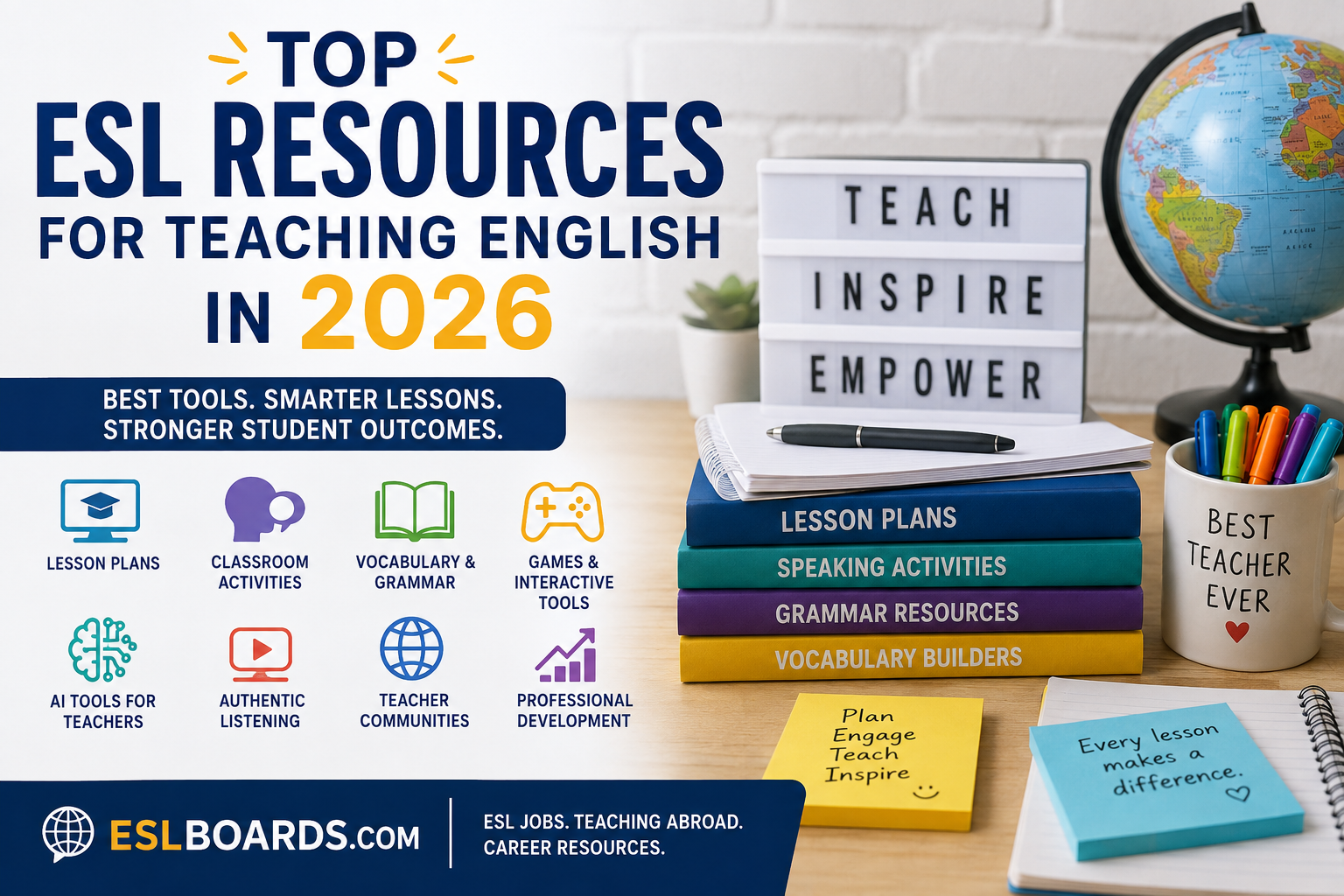
Top ESL Resources for Teaching English in 2026
Teaching English as a Second Language continues to evolve rapidly in 2026. ESL teachers now have access to more lesson-planning tools, interactive classroom platforms, AI-powered resources, professional development materials, and online teaching communities than ever before.
The challenge is no longer finding ESL resources — it is deciding which resources are actually worth using.
Whether you teach English abroad, work at a language school, teach online, or are just beginning your ESL career, these are some of the best resources for ESL teachers in 2026.
1. ESLBoards.com — ESL Jobs, Career Resources, and Teacher Community
Best for: Finding ESL jobs and building your teaching career
For teachers looking beyond lesson plans and toward their overall ESL career, ESLBoards.com is a valuable resource for discovering teaching opportunities and staying connected with the international ESL employment market.
ESL teachers can use ESLBoards to explore:
-
ESL teaching jobs
-
International teaching opportunities
-
Career advice
-
Teaching-abroad information
-
ESL certification information
-
Employer opportunities
-
Resources for new and experienced teachers
As the ESL employment market becomes more competitive, teachers should think about their careers the same way professionals in other industries do: build qualifications, develop specialized skills, create a strong professional profile, and actively monitor new opportunities.
Best tip for 2026: Don't wait until you need a new job to start researching ESL opportunities. Follow the market regularly so you know which countries, schools, and qualifications are in demand.
2. British Council TeachingEnglish
Best for: Free ESL lesson plans and teacher development
The British Council's TeachingEnglish platform remains one of the strongest free resources available to English teachers.
The platform offers lesson plans and classroom resources for primary, secondary, and adult English learners, along with teacher-development materials, courses, podcasts, videos, and professional resources.
Teachers can find materials covering areas such as:
-
Speaking
-
Listening
-
Reading
-
Writing
-
Vocabulary
-
Grammar
-
Business English
-
Young learners
-
Adult ESL
-
Teacher development
The British Council is also increasingly addressing issues affecting the modern classroom, including AI in English-language teaching, inclusive education, and multilingual learning.
Why ESL teachers should use it
Instead of creating every lesson from scratch, teachers can start with professionally developed material and adapt it to the needs of their students.
Best for: Teachers who want reliable, classroom-ready materials without paying for an expensive curriculum subscription.
3. Cambridge English Teacher Resources
Best for: Academic English and exam preparation
Cambridge English provides an extensive collection of resources for English-language teachers.
Its teacher resources include free lesson plans, teacher guides, handbooks, vocabulary lists, sample examination papers, speaking-test examples, and resources for teaching English online.
This makes Cambridge especially useful for teachers preparing students for internationally recognized English examinations.
Teachers can use Cambridge resources for:
-
Exam preparation
-
Academic English
-
Speaking practice
-
Vocabulary development
-
Assessment
-
Classroom activities
-
Teacher professional development
Teaching tip
Even if your students are not preparing for a Cambridge examination, exam-style speaking and writing activities can be excellent structured classroom exercises.
4. Quizlet
Best for: Vocabulary and independent practice
Vocabulary remains one of the most important parts of language acquisition, and Quizlet continues to be a useful tool for helping students practice new words and concepts.
Teachers can create or use existing flashcard sets and turn vocabulary into interactive study activities.
Quizlet has also expanded its AI capabilities. Teachers can use its AI tools to transform notes, readings, and slides into resources such as flashcards, study guides, and practice tests.
This can be particularly effective for ESL classes involving:
-
Vocabulary lists
-
Business English terminology
-
TOEFL vocabulary
-
IELTS vocabulary
-
Idioms
-
Phrasal verbs
-
Academic English
-
Workplace English
ESL classroom idea
Create a vocabulary set before each unit and ask students to study it before class. Classroom time can then focus more heavily on actually using the vocabulary in conversation.
5. Kahoot!
Best for: Games, review activities, and classroom engagement
Sometimes students need a break from traditional worksheets.
Kahoot! allows teachers to create interactive quizzes and classroom competitions that can make review sessions much more engaging.
Teachers can still host Kahoot activities using a free account, although some larger-class and premium functionality requires paid plans.
Kahoot works particularly well for reviewing:
-
Vocabulary
-
Grammar
-
Phrasal verbs
-
Idioms
-
Reading comprehension
-
Listening questions
-
Cultural knowledge
-
Test preparation
ESL classroom idea
Create a 10-question Kahoot during the final 15 minutes of class reviewing material students learned that day.
Students often become much more enthusiastic about review when it feels like a competition.
6. AI Tools for ESL Lesson Planning
Best for: Saving teachers preparation time
Artificial intelligence has become one of the biggest changes in education.
For ESL teachers, AI can be particularly useful because language instruction requires enormous amounts of customized content.
Teachers can use generative AI to help create:
-
Lesson-plan ideas
-
Vocabulary exercises
-
Discussion questions
-
Reading passages
-
Grammar exercises
-
Role-playing scenarios
-
Writing prompts
-
Comprehension questions
-
Quizzes
-
Rubrics
-
Differentiated activities
For example, instead of searching for an intermediate-level reading passage about travel, a teacher can ask an AI assistant to create one specifically for B1 English learners, followed by vocabulary exercises and discussion questions.
But AI should not replace the teacher
AI-generated teaching materials should always be reviewed.
Teachers still need to determine whether materials are accurate, culturally appropriate, level-appropriate, and suitable for their particular students.
The strongest model for 2026 is:
Teacher + AI — not AI instead of the teacher.
7. YouTube
Best for: Authentic listening practice
YouTube remains an enormous source of authentic English-language material.
Teachers can use:
-
Interviews
-
News clips
-
Documentaries
-
Travel videos
-
Short educational videos
-
Product advertisements
-
Movie clips
-
Public speeches
-
Tutorials
Authentic video helps expose students to different accents, speaking speeds, vocabulary, and real-world communication.
ESL classroom idea
Choose a short two- to five-minute video.
Before watching, give students five vocabulary words.
Then:
First viewing: Students listen for the main idea.
Second viewing: Students answer comprehension questions.
Third viewing: Students identify useful vocabulary or expressions.
Finally, students discuss the topic in pairs.
A five-minute video can easily become a 30-minute ESL lesson.
8. Podcasts
Best for: Listening skills and advanced students
Podcasts are excellent for intermediate and advanced ESL learners because they expose students to natural spoken English.
Teachers can use podcasts to develop:
-
Listening comprehension
-
Note-taking
-
Vocabulary
-
Pronunciation awareness
-
Discussion skills
-
Critical thinking
Students can listen to a short segment and summarize what they heard.
Advanced students can listen to longer episodes outside of class and give presentations about them.
9. News Websites
Best for: Current-events lessons
News articles can create some of the best ESL discussion classes.
Teachers can select a current article and build a lesson around:
-
Vocabulary
-
Reading comprehension
-
Main ideas
-
Opinions
-
Debate
-
Writing
News-based lessons are particularly effective with adult learners because students are learning English while simultaneously discussing real-world issues.
Teachers should select articles carefully and match vocabulary complexity to the students' proficiency level.
10. Canva
Best for: Creating professional teaching materials
ESL teachers increasingly create their own digital classroom materials.
Design platforms such as Canva can help teachers produce:
-
Worksheets
-
Vocabulary cards
-
Classroom posters
-
Presentations
-
Certificates
-
Infographics
-
Social-media-style assignments
-
Flashcards
Visual materials are particularly useful for beginner-level ESL students because images help teachers explain meaning without constantly translating vocabulary.
11. Google Docs and Google Slides
Best for: Collaborative ESL assignments
Collaborative documents can transform writing classes.
Instead of having students submit individual worksheets, teachers can create shared activities where students work together.
Students can use collaborative documents for:
-
Group writing
-
Peer editing
-
Vocabulary exercises
-
Research assignments
-
Presentations
-
Story writing
-
Business English projects
Teachers can also leave comments directly on students' writing.
For hybrid and online ESL courses, collaborative documents can become a central part of the classroom.
12. Online Dictionaries
Best for: Vocabulary development
Students should learn how to use a good English dictionary rather than immediately translating every unfamiliar word into their first language.
English-language dictionaries can help students understand:
-
Definitions
-
Pronunciation
-
Word forms
-
Example sentences
-
Collocations
-
Synonyms
-
Usage
Encourage intermediate and advanced students to look up definitions in English first.
This helps students begin thinking directly in English rather than constantly translating.
13. ESL Teacher Communities
Best for: Getting advice from other teachers
Some of the most useful ESL knowledge does not come from textbooks.
It comes from other teachers.
Teacher communities can help educators learn about:
-
Schools
-
Countries
-
Visas
-
Salaries
-
Classroom management
-
Lesson ideas
-
Teaching contracts
-
Certifications
-
Career opportunities
Experienced teachers can also help new teachers understand what teaching abroad is actually like.
This type of professional networking is one reason ESL career communities and employment platforms such as ESLBoards.com can become increasingly valuable to teachers.
14. TESOL and ESL Certification Programs
Best for: Professional development
Online resources are useful, but professional training remains important.
Teachers who want to build a long-term ESL career should consider developing skills in areas such as:
-
TESOL methodology
-
Lesson planning
-
Classroom management
-
Second-language acquisition
-
Teaching grammar
-
Teaching pronunciation
-
Assessment
-
Teaching young learners
-
Business English
-
Teaching English online
A stronger teaching qualification can also make a teacher more competitive when applying for international ESL positions.
15. Your Own ESL Resource Library
One of the smartest things an ESL teacher can do is create a personal digital teaching library.
Create folders for:
Speaking
Listening
Reading
Writing
Grammar
Vocabulary
Games
Business English
IELTS
TOEFL
Young Learners
Adult ESL
AI Prompts
Emergency Lessons
Whenever you create or discover a great activity, save it.
After several years of teaching, you can develop hundreds of proven classroom activities that can be adapted to almost any class.
What Makes a Great ESL Resource in 2026?
The best ESL resource is not necessarily the newest technology.
A good resource should help students communicate more effectively in English.
Before using any teaching tool, ask:
-
Does this get students speaking?
-
Does it match their English level?
-
Does it support the lesson objective?
-
Is it easy for students to understand?
-
Does it encourage active participation?
-
Can I adapt it for different learners?
-
Does it save teaching or preparation time?
Technology should support good teaching — not distract from it.
The Future of ESL Teaching
The ESL classroom of 2026 looks very different from the classroom of ten years ago.
Teachers now have access to AI-generated materials, online learning platforms, video resources, interactive games, collaborative documents, digital assessments, and global teaching communities.
But the most important part of language learning has not changed.
Students need opportunities to communicate.
The best ESL teachers will use technology to create more opportunities for students to speak, listen, read, write, collaborate, and interact in English.
AI may help create the lesson.
Technology may deliver the lesson.
But great teachers create the environment where students become confident English speakers.
Find Your Next ESL Opportunity
Looking for your next English-teaching position?
Explore ESL teaching jobs, international opportunities, teaching resources, and career information on ESLBoards.com.
Whether you're an experienced ESL instructor or preparing for your first teaching-abroad position, ESLBoards can help you take the next step in your ESL career.
Start exploring ESL opportunities today at ESLBoards.com.